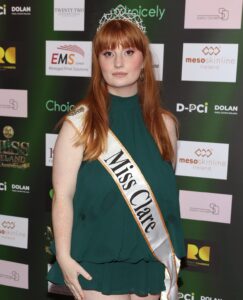


*Ann Marie Flanagan.
ENNISTYMON disabled rights campaigner Ann Marie Flanagan will form part of a delegation meeting the Minister for Public Expenditure and the Minister for Social Protection to discuss cost of disability supports.
Ann Marie will join Director of Strategic Partnerships with the Irish Centre for Diversity, James Cawley Jnr, senior accessibility engineer Brian Dalton to meet with Minister for Public Expenditure, Infrastructure, Public Service Reform and Digitalisation, Jack Chambers (FF) and Minister for Social Protection, Dara Calleary (FF) in Leinster House on Wednesday.


During the meeting, the delegation will seek a fully refundable €500 Cost of Disability tax credit in 2027 for working disabled people excluded from the payment announced in Budget 2027. Full refundability would ensure eligible people receive the entire credit even where their income tax liability is below €500.
According to Ann Marie, “Our disability costs do not disappear when we go to work. Working does not remove the additional exorbitant costs of accessible transport, equipment, heating, adaptations, essential equipment and much more. For many disabled people, employment brings extra costs because we need to pay for a second person to travel with us, assist us or enable us to participate safely and fully in work and everyday life.
“Living in rural Clare, I know how essential suitable transport is. We have to pay for adapted vehicles, bring a second person with us and pay for their expenses. On the rare occasion that a taxi is available, the meter starts running before the driver even gets out and begins taking out the ramp. These are real costs of participating in everyday life, including employment. We welcome the opportunity to meet Minister Chambers and Minister Calleary and appreciate the time they are making available. We are bringing a practical proposal that would put €500 back into the pockets of working Disabled People who are currently excluded,” she added.
Of the proposal, she estimated that it could cost approximately 15c of every €100 the State collects in tax revenue. “Recognising the additional costs of disability is a human rights issue. Disabled People should not have to choose between participating in society and being able to afford the support, transport, equipment or assistance that makes participation possible.
“These costs must be recognised without reducing Disabled People’s lives to a price tag or treating equality as a commercial transaction. Financial support is necessary because exclusion has a material cost, but the purpose is not to commodify disability. It is to uphold our right to live, work and participate in society on an equal basis. Cost of Disability support must therefore be standalone and non-means-tested. It should recognise the unavoidable and ongoing costs Disabled People face, whether we are working or receiving social welfare, while respecting our dignity, autonomy and equal citizenship. Those costs can include transport, adapted vehicles, equipment, heating, food, clothing, home adaptations, paying for a second person to enable us to participate in society and other expenses arising from disability. They are often unavoidable, ongoing and not covered by existing supports,” Ann Marie added.
Separating medical cards, free travel from disability allowance eligibility will also form part of the ask from the delegation which they believe will help disabled people that receive the allowance progress into full-time employment without losing the support.
An input via an open, democratic and accessible process for disabled people into co-design will also be sought by the delegation.