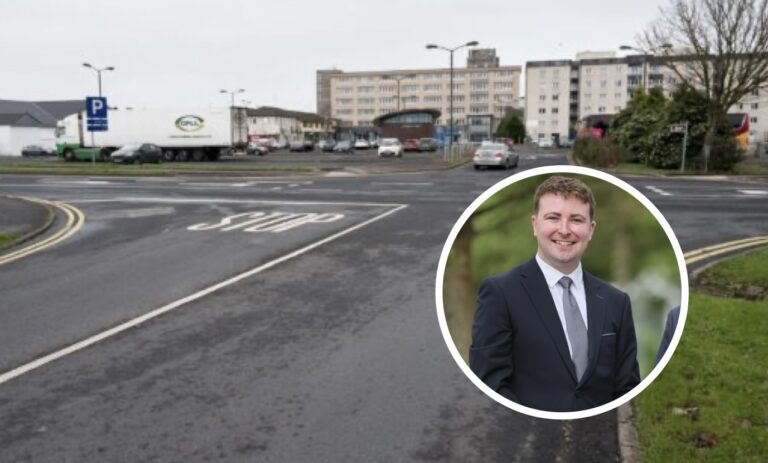

*Bothár na Rinne Shannon Town Centre || Inset: Cllr David Griffin
POTHOLES, defective footpaths and deteriorating road edges feature among the most frequently reported maintenance issues across Clare, while the council says it cannot currently provide a breakdown of the cost of resolving individual complaints.
Director of Services Carmel Kirby provided the figures in response to a question from Cllr David Griffin (FF), who sought a breakdown of maintenance requests received and closed out in each municipal district, along with the most common issues reported.



The council uses its customer relationship management (CRM) and works management processes to record, monitor and respond to maintenance requests.
In an earlier response to Cllr Griffin, the council cautioned that CRM figures did not provide a complete record of maintenance requests, as duplicate reports, issues dealt with immediately and requests made directly to staff by email or verbally were not always recorded. It said a standardised approach to logging queries and complaints would be considered to improve consistency and provide more reliable statistics.
Ennis Municipal District logged 553 maintenance requests, with 367 closed out during the reporting period.
Potholes were the most frequently reported issue, accounting for 79 requests, followed by defective footpaths (58), dangerous junctions or stretches of road (53), overgrown grass verges (42) and overhanging trees (34).
Killaloe Municipal District recorded 554 requests, with 371 closed out. Its most frequently reported issues were road edges subsiding or wearing away (48), overgrown hedges (43), dangerous junctions or stretches of road (38), potholes (33) and defective footpaths (29).
Shannon Municipal District recorded the highest number of requests, with 986 received and 555 closed out during the five-month period specified for that figure in the council’s response.
The main issues listed were potholes, overgrown hedges, grass cutting in estates, defective footpaths and blocked road gullies.
In West Clare, the Ennistymon local electoral area (LEA) recorded 202 requests, with 72 closed out, while the Kilrush LEA recorded 273 requests, with 180 closed out.
Potholes were the most frequently reported issue in both areas, accounting for 49 requests in Ennistymon and 50 in Kilrush.
In Ennistymon, the next most common issues were overgrown hedges and trees (31), defective footpaths (18), signage (16) and dangerous junctions (11).
In Kilrush, the next most frequently reported issues were overgrown hedges, trees and grass (41), deteriorating road edges (30), defective footpaths (24) and blocked road gullies (21).
Cllr Griffin had also requested details of the resources spent addressing maintenance issues in each municipal district and the changes introduced since his earlier question in April to improve tracking and transparency.
In her written response, Ms Kirby said the council’s financial and operational systems were not configured to allocate costs to individual CRM requests or maintenance complaints.
She said the council recorded spending on labour, materials, machinery and contractors through its financial and payroll systems, but these costs were generally recorded against broader programmes rather than individual maintenance requests.
Compiling a precise breakdown of costs associated with specific maintenance issues would require a significant manual exercise across multiple systems and records, she said. This would place an administrative burden on operational staff and divert resources from service delivery.
Ms Kirby said municipal district offices continued to use and develop CRM and works management processes, with reviews aimed at improving data quality, reporting and workflow management.
The council intends to develop a standardised approach to logging customer queries, complaints and service requests across the organisation.
Speaking at the meeting, Cllr Griffin acknowledged the commitment to tracking requests at municipal district level.
Ms Kirby said she could not provide a timeline at present, but that the work remained among the council’s priorities.
Funded by the Local Democracy Reporting Scheme