A RACONTEUR and storyteller who circumnavigated the world twice over, Newmarket-on-Fergus native PJ Reidy had a send-off like no other when he was laid to rest last week.
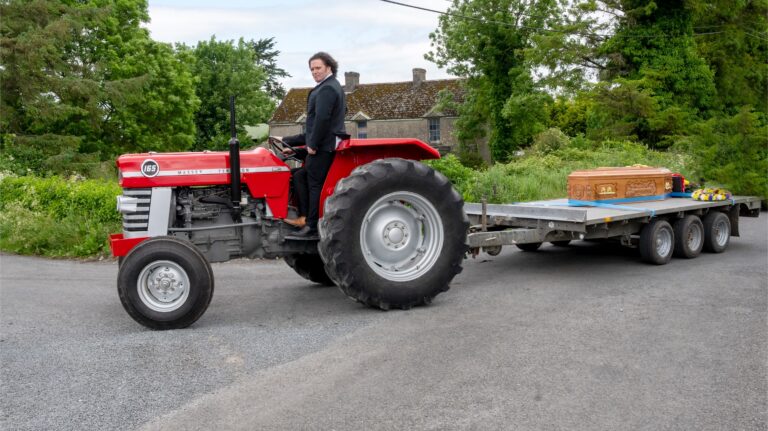
It was “a tractor and trailer send-off” as his son John described it from the altar of Carrygerry Church on Friday morning with his coffin strapped into a trailer attached to a Massey Ferguson 165 as he made his final journey to Kilconry Cemetery.
Journeys were incredibly important to PJ who first went abroad in 1956 at the age of nineteen. Every June, he would travel across the globe for three weeks and during the course of his life, the eighty nine year old managed to circumnavigate the world twice, thanks to his annual expeditions.
In total, he managed to visit an estimated twenty five countries, the details of which he wrote on lime in his barn at home in Treannahow. Along the way, he competed in a cycle in New York City in 2005, comforted a Barcelona team with a pep talk at an airport in Italy, listened to and told an awful lot of stories.
Speaking at PJ’s funeral mass, Fr Albert McDonnell stated, “he travelled a great deal, not just within Ireland or Europe but far beyond”. Such locations included New York, Montserrat, Bermuda, Greece, Hong Kong and the Iron Curtain.
Aer Lingus was a natural fit for PJ’s employment and it comes as no great surprise that he held a strong interest in aviation. Through his farming, he remained connected to the land but was never driven to have the biggest herd and he was compared as a cross between Johnny Appleseed and Finn MacCumhaill.
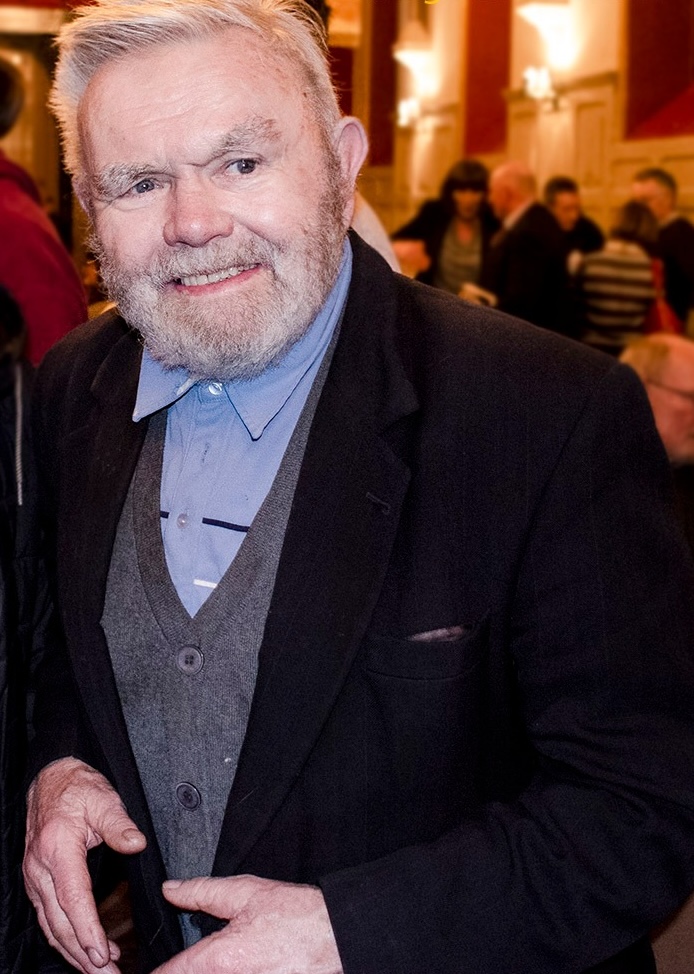
Well respected for his love and knowledge of history, PJ was a genealogist without the qualifications and could distinguish between different people of the same name in localities. He led historical walks and talks in Newmarket-on-Fergus but was active with groups across the region and highly regarded by them. He was liked by so many because of how helpful he was.
Born on January 20th 1937, PJ died peacefully at University Hospital Limerick on May 25th 2026, ironically days short of when his annual June expeditions would have traditionally begun. His father Pat was a member of the East Clare IRA Brigade and his mother Anne was a member of Cumann na mBan. His beloved wife Nora died in June 2022. His three O’Grady granduncles were members of the first local football team The Dalgais who represented Clare in the All-Ireland Championship in the late 1880s.
His son Martin spoke of his father’s stories from travelling the world every June “so he could get the hay done in August”. He said his father had polished the art of storytelling. “Even in the last twelve months at eighty nine and a quarter we got up on a hot air balloon in Trim, Co Meath, we left at 4am to be at the petrol station for 06:30, it was the fourth time that summer we tried to get it done, we got a lot in”.
Local historian Máire Ní Ghruagáin who was co-author of ‘The Story of Newmarket-on-Fergus’ alongside the late Canon Reuben Butler can recall first listening to PJ’s stories “a long time ago”. She recounted it as “a chance I nearly forfeited only for a warning that he was taking note of how I dismissed myself from his company. ‘You had better entertain that man. He’s the best we have coming to visit,’ I was told. I prepared well for the next visit, planning which I did to take the ball in my own hands and ask the questions that would get to the base of his popularity and reputation as a well-travelled self-educated man. What I found out would make along with your own memories, a chapter in the Fest Schrift which undoubtedly, we should between us, place before an interested public to enthrall and delight them as PJ has done us”.
PJ’s deeds are worthy of publication in a book, Máire maintained. She remembered him as someone “with great humanity and an ability to provide an original solution for anyone who made his way to his workspace. She noted that his step-uncle Pat Hamill developed and patented a wall surface which is now held in the patents office in Washington. “At the home front his solution for ivy damage to wall structure was to pull it and feed it to cattle. A task like the other he undertook himself immediately. A man like his hero Jeremiah Kerin who saved the lives of two Kilconry men ‘fit for any seaport town’,” she added.
Martin O’Grady, a former colleague of PJ’s recalled how when his swath turner broke down with pins missing and deemed irreplaceable in Ireland, PJ travelled to the manufacturer in between flights and to the delight of management, he left with bags of many parts, and the missing pins which he loaded in his waiting plane.
This according to Máire demonstrated PJ’s character, “That’s not ordinary stubbornness. It’s the foundation of a strong will laced with the vision of genius that endows one to pursue the improbable and take on the impossible in small but measured steps. It’s the ‘I ask why not’ of the late John F Kennedy and something in the shy country boy from Carrygerry. What he achieved is the result of such determination. We shall be talking and writing about PJ Reidy for a long time yet”.
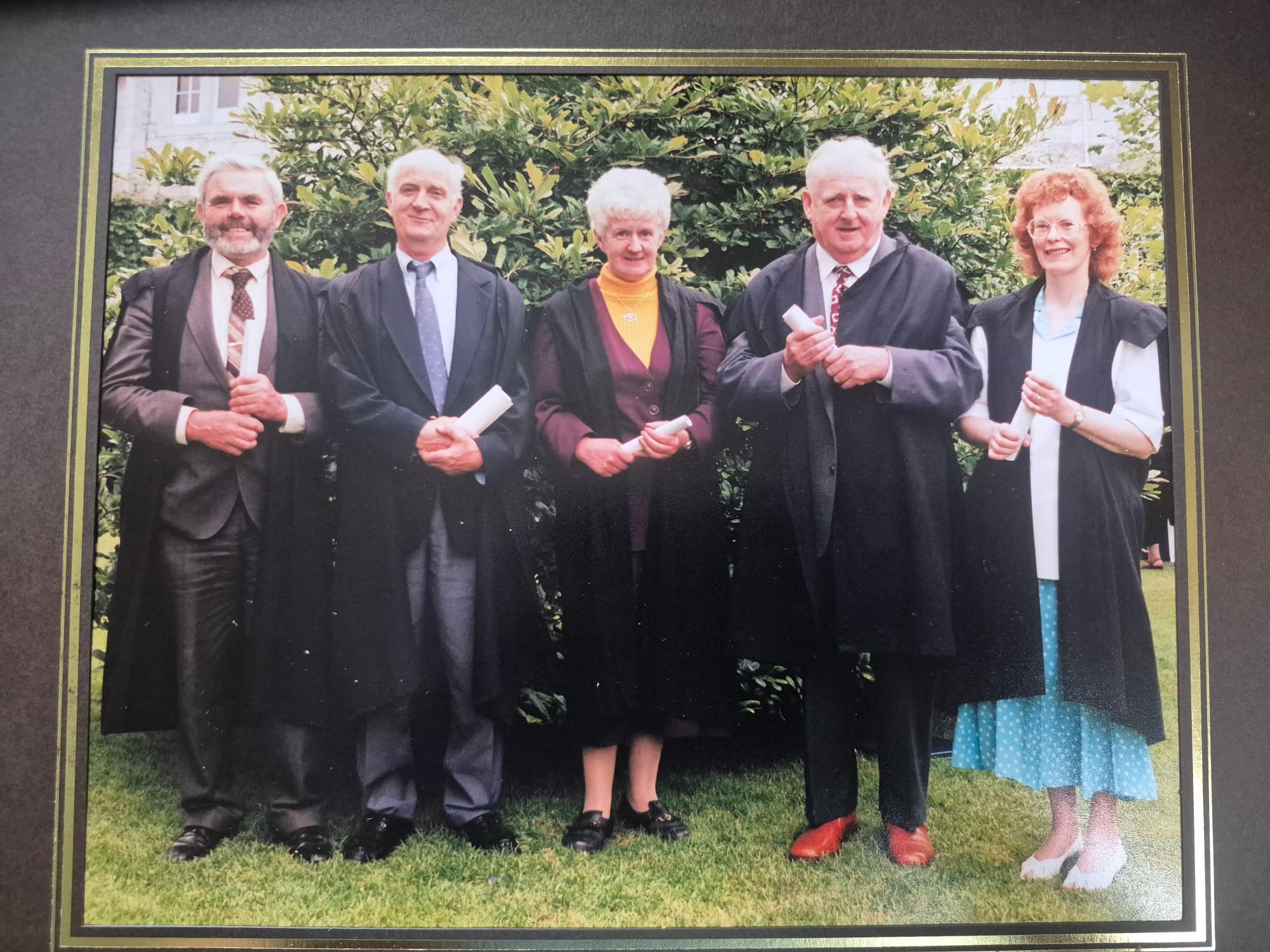 Alongside Máire, Labhrás Ó Donnghaile, John O’Dea and Marion O’Leary, PJ completed a diploma course in local studies from the UCC. He did his thesis on emigration from twenty one townlands within Newmarket-on-Fergus.
South Africa based, Sr Clare Hegarty remembered PJ as “a wonderful local historian and our Mom always liked to listen to his stories when she got a chance. I always visited the Reidys when I was home and they took me on many an interesting trip”. Tim Crowe of the Sixmilebridge Historical Society said PJ “was a great historian and great company. Great local knowledge passes with PJ”.
Researcher, Luke McInerney said PJ was “a very well-liked gentleman whose devotion to the locale was impressive. His head was full of seanchas and scéalta. The likes of him will hardly be seen again”.
PJ is survived by his his sons Martin and John, grandson Marcus, nephews-in-law, cousins, extended family and friends.