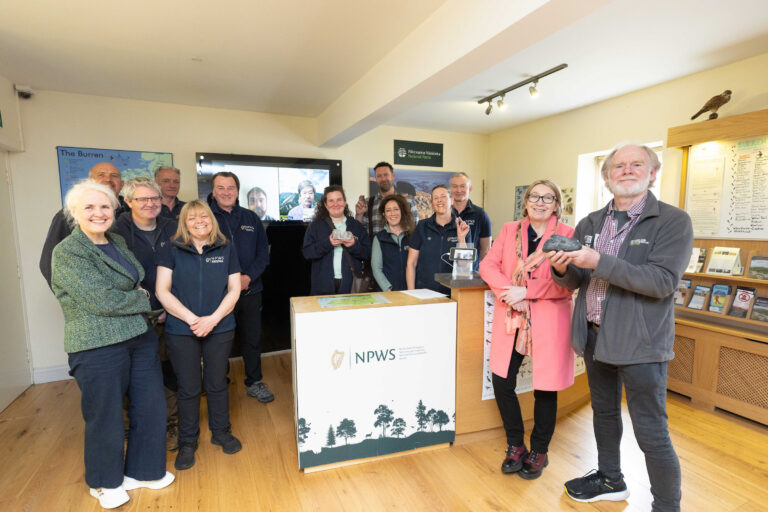

*Pictured: Celebrating recent fossil discoveries in the Burren National Park Interpretation Centre (L-R): Carol Gleeson, UNESCO Burren Geopark Project Manager, Clare County Council; Flan Davoran, Eamonn Twomey, Michael Killeen, Michele Taylor, Sean Forde, Megan Lee, Helen Carty, Phoebe Larkin and Niall O’Reilly, NPWS Staff; Catriona Ryan, Director of the NPWS and Dr Eamon Doyle, Geologist, Clare County Council and Burren and Cliffs of Moher UNESCO Global Geopark.
THREE-hundred-and-thirty-million-year-old teeth and a fin spine from fossil sharks have been found in the Burren, County Clare, and in Donegal.
The fossils were identified by Clare County Council and Burren and Cliffs of Moher UNESCO Global Geopark Geologist Dr Eamon Doyle, and his colleagues Dr Wayne Itano of University of Boulder, Colorado, and Dr Aodhán Ó Gogáin of National Museum of Ireland.
Discovered in the Burren and in Donegal by Phoebe Larkin and Emma Glanville of the National Parks and Wildlife Service (NPWS) and local guide Cormac McGinley respectively, this is the first record of these unusual fossil shark teeth in the Burren.
The Burren teeth have been identified as Psephodus magnus, a type of shark that had flat, robust dental plates for crushing prey such as shellfish. There are few modern relatives of these fish, but they are distantly related to the modern deep-sea ratfish. The fin spine from Donegal belonged to Oracanthus milleri, an example of an extinct lineage of shark-like fossils known as acanthodians or spiny sharks from which all sharks evolved over 400 million years ago.
The specimens added to ongoing active research into other Carboniferous fossil fish by lead author Dr Doyle, who said, “It was exciting to be notified of these discoveries, as they are the first ever records of any kind of fossil fish from these locations. In addition, it is important to note that they were not found by trained palaeontologists but by people who keep an eye out for interesting things in the rocks where they work – a good example of citizen science.”
Dr Itano added, “Despite having worked on these types of fossil sharks for many years there is still a huge amount that is unknown about them, so every new find is significant. These Irish examples add to the evolving global story of ancient fossil sharks.”
Dr Ó Gogáin said, “It was important to record these finds scientifically in a peer-reviewed journal that will be a permanent record available to other palaeontologists and the general public for generations to come. Further research is ongoing and we hope to add to these finds in the coming years.”
Dr Eamon Doyle and his palaeontologist colleagues’ journal is available as an open access preprint at: https://doi.org/10.1353/ijes.0.a987808
Phoebe Larkin of the NPWS commented, “While the primary focus of the NPWS is on modern-day biodiversity, it is important to note that the Burren contains a significant record of ancient biodiversity as well, and we are delighted to have contributed this new material.”
Anybody who finds something they think might be an interesting fossil is encouraged to leave it in place and send a photograph to info@burrengeopark.ie, where it will be assessed and hopefully identified.
The Burren and Cliffs of Moher UNESCO Global Geopark is managed by Clare County Council and supported by Geological Survey Ireland.