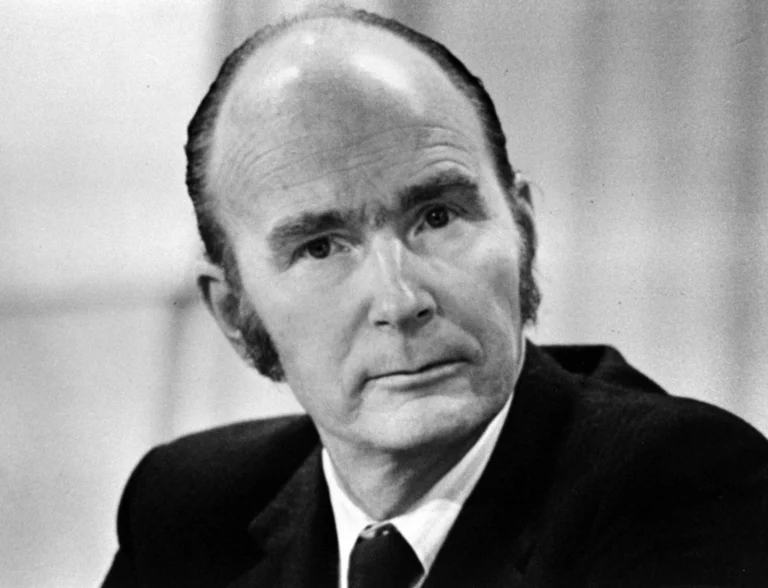
*Dr Patrick Hillery.
Dr. Patrick Hillery was not a politician, he proved to be a statesman.
Kilkishen native and retired professor at NYCCT/Marymount Manhattan College, Patrick O’Halloran reflects on the career of Dr Hillery and says his dedication to the next generation is not evident with the politicians of today.
Patrick Hillery was born in 1923 in Spanish Point, County Clare. The son of Dr. Michael Joseph Hillery and Ellen McMahon a district nurse. Patrick attended Milltown Malbay National School, Rockwell College and at third level he attended University College Dublin, qualified with a degree in medicine.
In 1947, he returned to Milltown Malbay and followed in his father’s footsteps as the local doctor. In the 1950’s he served as a member of the National Health Council as well as Medical Officer for the Milltown Malbay Dispensary District and also spend a year working as coroner for West Clare. In 1955 he married Dr. Maeve Finnegan an anesthesiologist. Together they had a son John and a daughter Vivienne who passed in 1987 shortly before her eighteenth birthday after a long illness.
Ironically Dr Hillery did not see himself as a politician. As a result of extreme pressure from Clare’s senior Fianna Fáil TD and party leader Éamon de Valera, he agreed to become de Valera’s running mate in the 1951 general election. Both de Valera and Dr. Hillery were elected. When de Valera was elected President of Ireland in 1959, Seán Lemass succeeded him as Taoiseach.
Lemass appointed Dr. Hillery Minister for Education in 1959. It is important to note that upon taking the Education brief, Minister Hillery proved to be an innovative, forward thinking, policy driven educational reformer. In 1963, as Minister for Education, Dr. Hillery made a major policy speech in which he outlined many of the educational reforms that were introduced into law over the next decade. These reforms included increased educational opportunities for many, the establishment of both comprehensive schools and regional colleges. Included also in these proposals were access for students to all public examinations.
While Donogh O’Malley has been credited for introducing free education, the fact is that Dr. Hillery laid the groundwork before the passing of these landmark legislation policies. By 1965 Dr. Hillery held the ministerial brief for Industry and Commerce. This department under Dr. Hillery was responsible for kick starting the Irish economy at that time.
By late 1966 Lemass appointed Dr. Hillery the first ever Minister of Labour. Lemass chose Dr. Hillery for this post due to the fact that industrial disputes began to take their toll on the government at this juncture. Lemass felt that he could depend on Dr. Hillery to address these disputes and find a compromise that both the government of the day and labour unions could live by. This new department had been an ambition of Lemass for several years as he was aware that industrial disputes would be detrimental to the government’s economic agenda both in the short and long term. Dr. Hillery was appointed to this office based on his previous proved track record as an effective legislator and facilitator.
When Seán Lemass resigned as Taoiseach in November 1966, he asked Dr. Hillery to allow his name to go forward for the leadership of the party. Once again, Dr. Hillery declined the opportunity to advance his political career, stating that he had “no interest in the position”.
Jack Lynch succeeded Lemass after a leadership contest with George Colley. Such was Dr. Hillery’s reputation as a legislator, Lynch’s first ministerial appointment was to ensure that Dr. Hillery retained the Labour portfolio. When Fianna Fáil was victorious in the 1969 general election, Dr. Hillery was appointed Minister for External Affairs, renamed Foreign Affairs in 1971. This ministerial office was considered one of the most prestigious of cabinet posts. Dr. Hillery earned a positive international profile when, in the aftermath of the killing of fourteen unarmed civilians in Derry by British paratroopers, Dr. Hillery travelled to the United Nations in New York City and demanded UN involvement in peace keeping on the streets of Northern Ireland. This drew worldwide attention to the worsening situation in the north of Ireland.
At the contentious Fianna Fáil Ard Fheis in 1971, some party members launched a very vocal and public attack on the party’s leadership stance with regard to Northern Ireland. Kevin Boland was one such member to do so. While some of Boland’s supporters started chanting, “we want Boland”, Dr. Hillery showed his resilience and loyalty by grabbing the nearest microphone and shouted down the Boland faction with the memorable line, “you can have Boland, but ye can’t have Fianna Fáil”.
While dealing with the affairs of Northern Ireland, Dr. Hillery also negotiated Ireland’s membership of the European Economic Community (EEC), which was completed in 1973. As a result of Dr. Hillery’s ability to successfully negotiate entry to the ECC, he was rewarded by becoming the first politician to serve as the country’s European Commissioner. Dr. Hillery was appointed Vice President of the European Commission and also European Commissioner for Social Affairs, he proved to be a most capable and effective policy driven legislator within the EEC. His most famous policy initiative was to force EEC member states to give equal pay to women.
In 1976 the then Irish government, Fine Gael/Labour Party National Coalition, under Taoiseach Liam Cosgrave, did not re-appoint Patrick Hillery as EEC commissioner. At this stage, Dr. Hillery considered returning to the medical field, moving with his wife Maeve who was also a doctor, to Africa.
Fate would ensure that again Dr. Hillery’s political career was not over due to the then Minister of Defence, Paddy Donegan ferocious verbal attack on President Cearbhall Ó Dálaigh calling him a “thundering disgrace” for referring anti-terrorist legislation to the Supreme Court of Ireland to test its constitutionality. President Ó Dálaigh resigned as a result and a deeply reluctant Dr. Hillery agreed to become the Fianna Fáil candidate for president. In light of the drama with President Ó Dálaigh, both Fine Gael and Labour decided not to nominate a candidate. As a result, Dr. Hillery was elected unopposed, becoming President of Ireland on December 3 1976.
In 1983 Dr. Hillery was re-elected unopposed. He left office in 1990 having served the maximum two terms and retired from public life. President Hillery should be recognized for his integrity, honesty, devotion to duty as well as for the implementation of legislation that was so beneficial to not alone to the people of Ireland but also to the EEC community.
President Hillery’s reputation as an ethical and upright holder of the Irish Constitution was never more evident than the phone calls to Áras an Uachtaráin drama that took place in 1982. In January 1982, the Fine Gael-Labour Party coalition government of Taoiseach Garret Fitzgerald lost a budget vote in Dáil Éireann. As a result, Garret Fitzgerald went to the Áras to request for a dissolution of the Dáil, under Article 13.2.2. If President Hillery refused Fitzgerald’s request for a dissolution, Fitzgerald would have to resign. Had this happened, Charles Haughey, leader of the opposition would have been the next contender to form a government.
While President Hillery was considering Fitzgerald’s request, a series of phone calls were made by senior opposition figures requesting to speak with President Hillery. Their goal was to urge President Hillery to refuse the dissolution which would allow Mr. Haughey the opportunity to form a government. President Hillery was appalled and felt this was gross misconduct on behalf of the callers. He ordered one of his aides de camp, Captain Anthony Barber not to pass on any telephone calls from the opposition figures.
It appears that President Hillery due to his comprehensive and authoritative study of the Irish constitution may have been conflicted between the English and Gaelic versions of the Constitution. The English version of the constitution vests the President with certain powers that he uses “in his absolute discretion,” the Gaelic version states that these powers are used as a “chomhairle féin,” which appears to translate to “under his own counsel”. While “absolute discretion” implies that presidents have some latitude in whether to initiate contact with the opposition under these circumstances, “under his own counsel” has been interpreted to mean that no contact whatsoever can take place with the opposition. It is important to note whenever there is a conflict between the Gaelic and English versions, the Gaelic version takes precedence. President Hillery granted the dissolution. No President to date has ever refused to enact such a request.
It appears that the Irish public did not truly grasp how President Hillery’s honesty, integrity and devotion to duty was directly responsible for ensuring that the Irish constitution was upheld during a very volatile and challenging period in Irish politics until the 1990 presidential election as President Hillery was completing his maximum two terms in office. The clandestine and unethical actions of senior members of Fianna Fáil with regard to the dissolution of the Dáil came to light when Brian Lenihan, Fianna Fáil’s candidate for president confirmed on the record in a recorded interview with post-graduate student Jim Duffy who was researching the Irish presidency that he had been one of the opposition members phoning President Hillery in 1982 and that President Hillery was steadfast in refusing to accept any phone calls from at least four senior opposition figures. This revelation by Lenihan ironically resulted in him being the first Fianna Fáil candidate for President to fail to be elected.
Fast forward to 2002, Dr. Hillery’s international stature came to light when the state papers released by the British Public Record Office under the thirty-year rule was published in the Irish media which revealed how Dr. Hillery who at that time was Minister for Foreign Affairs was viewed by the English government. The briefing paper which was prepared by Foreign Secretary, Sir Alec Douglas-Home and Secretary of State for Northern Ireland, William Whitelaw noted that “Dr Hillery is a powerhouse of ideas, one of the few members of Fianna Fáil who has new policies and is eager to implement them. The example of this has been in his present job, where he has perforce concentrated on Anglo-Irish relations and in particular the North. Policy in this field is determined primarily between him and the Taoiseach; and it is likely that the Fianna Fáil new line on the North owes much to Dr. Hillery”.
In closing, it would be remiss of me if I did not mention some personal notes related to Dr. Hillery. When Dr. Hillery was EEC Commissioner he visited and spoke to the Leaving Certificate class of 1975 at his alma mater Rockwell College. When Dr. Hillery was informed that there was a student in the class from Kilkishen, County Clare, Dr. Hillery took time out of his very packed schedule to speak with me and wish me well post college. Of course, he mentioned that our local doctor in Kilkishen, Dr. Houlihan had been his classmate and fellow member of the college rugby team, a friendship that lasted throughout their lives. When Clare made the hurling breakthrough winning the National Hurling league in 1976 and 1977, President Hillery not alone attended both finals, he went to the dressing rooms after to congratulate both the players and coaching staff. Dr. Hillery, a man of the people who made the world a better place by his dedication to the next generation and not the next election. If only today’s politicians would do so, Thank you Dr. Hillery.
Pat O’Halloran is originally from Kilkishen, County Clare. He retired as a college professor recently, NYCCT/Marymount Manhattan College. He now lives in Tyrone, Georgia with his wife Tricia and their sons Eamonn and Bryce.