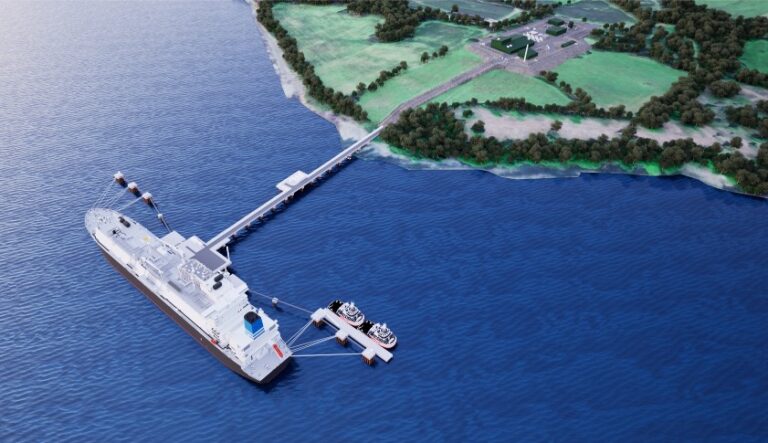
*An impression of the gas reserve.
UP TO 300 jobs will be created in West Clare, a sixth of which will become full-time posts, with the building of a strategic gas emergency reserve in Cahercon.
Gas Networks Ireland confirmed at the end of November that it has selected Cahercon along the Shannon Estuary as the location for Ireland’s new Strategic Gas Emergency Reserve (SGER).
Fourteen coastal sites were considered nationally with Cahercon making the final two where it was selected ahead of Cork Harbour. The Strategic Gas Emergency Reserve is a State-led project that will provide a temporary natural gas facility that can be used in the event of a disruption to Ireland’s gas supplies.
The new gas reserve will be delivered in the form of a Floating Storage and Regasification Unit (FSRU), which will be owned and operated on behalf of the State by Gas Networks Ireland.
Each site was evaluated against four specific criteria – technical, environmental, financial and planning. Following this comprehensive multi-criteria and cost-benefit analysis, plus its associated pipe route corridor, the site at Cahercon was deemed to best meet the project needs. The multi-acre site in Cahercon will be developed to include a deep-water jetty for a floating storage regasification unit (FRSU), an onshore facility, and a new connection to the national gas network.
Jason Murphy, Director of Service with Clare County Council confirmed to The Clare Echo that following their discussions with Gas Networks Ireland, up to 300 jobs will be provided in the construction of the project with forty to be maintained thereafter. He has asked Gas Networks Ireland to brief senior management of the Council, the Economic Development SPC and the West Clare Municipal District on their plans.
Senior planner with Clare County Council, Helen Quinn explained the facility will “ensure the national energy security for the country”. She added, “It will be called a regasification unit and store gas at a very low temperature to tap into national gas pipeline network to tap into”. She said it is likely the planning application will go directly to An Coimisiún Pleanála.
An open evening has already took place in Kildysart where Gas Networks briefed locals on their plans. “There was huge engagement from the local community about the new proposal, there is a very measurable response from the local community, they are looking forward to more engagement with the community. If the proposal goes through planning system it will take some years before the planning is achieved and construction of the jetty, it will be about a two-year construction process,” Cllr Michael Shannon (FF) outlined. He said between 40-50 people will have permanent employment as a result of the gas reserve.
Bobby Gleeson, Chief Operating Officer of Gas Networks Ireland advised, “We will be keeping local stakeholders updated and informed throughout this process. He said Cahercon’s selection was “a very significant milestone”.
Ireland needs a temporary strategic gas emergency reserve because it currently imports 80% of its natural gas via two interconnectors from Britain. Any interruption to that supply would have a severe impact on electricity and heating to homes and businesses. Gas currently provides about 30% of Ireland’s primary energy needs and typically generates more than 40% of our electricity. At peak demand, gas can supply up to 80% of Ireland’s electricity generation.
The Strategic Gas Emergency Reserve will help mitigate this risk, as it will provide an alternative gas supply in the form of Liquefied Natural Gas (LNG). The Floating Storage and Regasification Unit, which is central to the project, is a specialist ship that stores LNG at very low temperatures and then converts it to natural gas when required.
This vessel will be docked at a jetty in Caheracon and can deliver this natural gas to the existing gas network if required at any point. In the event of a major disruption to the current supply, the FRSU can be continuously re-supplied by sea until normal gas supplies are restored. FSRUs are a proven and safe technology which have been in use internationally for more than 20 years. There are currently more than 50 operating throughout the world.