
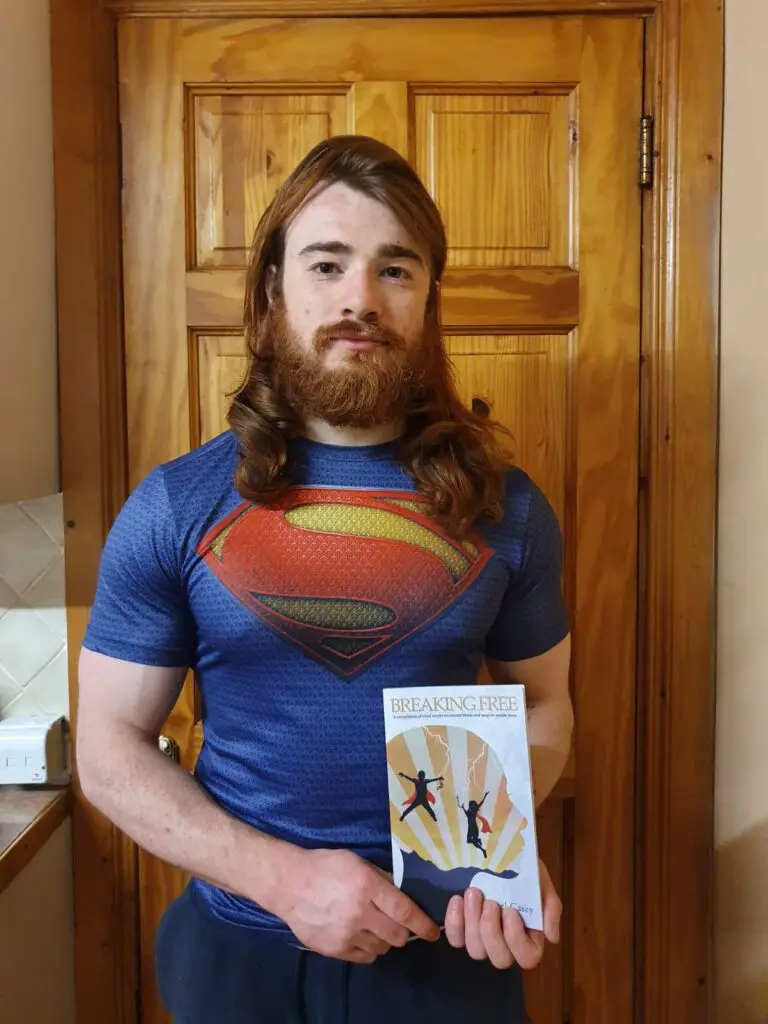
Clare man Michael Casey understands what it’s like to live with a disorder.
With a mental health crisis looming on the horizon, Michael encourages people to speak out, whether to a friend, family member or someone you can confide in. The World Health Organisation ranks Obsessive Compulsive Disorder (OCD) in the top ten debilitating illnesses worldwide. Throughout the pandemic, Michael spends his days working at the Clarecare over 65s Day Care Centre, delivering meals to the elderly.
Underneath all this, Michael battles his own bout with OCD and acknowledges the pain and hardship caused by ‘the doubting disease.’ Michael tells The Clare Echo about his journey with OCD, the confusion and misconception in the media around the disorder, the impact Covid-19 has had on those suffering and the power and importance of reaching out and asking for help.
Michael began to realise that something was different at five or six years old. At school, he began to rub words out, not just when he was mistaken but simply because they did not look perfect. A year later, Michael remembers kicking the ball in the air a certain amount of times, telling himself that if he didn’t something bad would happen.
It slowly began to get worse at secondary school and people began to notice. Michael would step between the cracks in the pavement on his way to lunch and handwashing became a huge feature during exams. Turning on and off light switches a specific amount of times also began to disturb him and he would often turn off taps so tightly that it was sometimes too difficult to turn them on again.
“I didn’t realise that I had it until about seventeen or eighteen. I didn’t get help until I was twenty, when it got really bad. I had it mixed in with depression. It spiralled out of control in college when I didn’t go in for a whole month. There was more relief than anything else when I found out that I had it. There was still a lot of shame and guilt. Two of the main traits of OCD are doubt and guilt. I felt guilty for having it. My family were confused. I had hid it really well. OCD is extremely stereotyped in the media. It is the reason why people with OCD keep it quiet. If you are neat and tidy, it doesn’t mean you have OCD, it just means you are neat and tidy. My family had a lot of confusion when they found out. For someone who doesn’t have it, it’s very hard to wrap your head around it. It’s one of the more misunderstood illnesses. If you have OCD, it’s not just about being neat and tidy, there are deeper levels.”
Varying levels of intensity bely the disorder and Michael admits that OCD finds that one thing you are most afraid of and highlights it. There are mild to severe cases across the spectrum. Some people won’t hug their children, fearing that they may contaminate them. Michael points to how religion exacerbated OCD decades ago, whereby people enveloped their innermost thoughts in sin, causing an awful lot of distress. Michael’s research into the debilitating illness showed him how people’s thoughts have destroyed their lives. Nobody wants to come forward and admit their deep and most destructive thoughts. Covid-19 has also impacted OCD in a dangerous way. Michael admits that the impact really relates to the intensity that someone is suffering at.
“For me, the coronavirus has made my OCD a bit more relaxed. For people with OCD, we have always felt that if we don’t wash our hands, something bad is going to happen. We didn’t know what that bad thing was going to be. It felt like we were preparing for the worst. Now, the thought is, if I don’t wash my hands, I might get Covid. This just gave us way more security as OCD is the fear of the unknown. Covid is known now and this has given us some reassurance in these times. It has relaxed me a lot because I see people washing their hands. Before this, I would see someone coming out of the bathroom without washing their hands and I wouldn’t be able to leave the bathroom without using a tissue to open the door on my way out. I always felt like the germs people had on their hands could lead to something worse. For me, now, I am able to put those thoughts out of the window.
“People will develop OCD because of this virus and I know there are some cases where people are afraid to leave their houses, for fear of catching the virus. Instead of washing their hands they won’t leave the house without performing rituals. Rituals are like turning off the light, washing your hands the correct number of times, arranging something or not being able to pass into the next room without performing a ritual like going in and out three times, before leaving the room. They think, if I don’t turn on and off the lights ten times, I will get Covid. For some people, this will cause a lot more anxiety in turning moderate OCD to severe.”
Last year, Michael undertook a personal project to understand OCD and various other mental illnesses and conditions. He penned a children’s novel, entitled ‘Breaking Free’, that looks at sixteen different conditions and disorders in a fictional sense, whereby a young protagonist comes to realise that they are not like everyone else. Michael admits that the project enabled him to break free of ignorance, making him more aware of the different mental illnesses that people suffer with.
One particular chapter relays Michael’s own journey of realising that he has OCD. On the project itself, Michael feels that it did not benefit his OCD in any way but did have a positive impact on his overall mental health and awareness of others. Each chapter contains traces of individuals he sought out online or in person, leaving the textbooks aside and instead opening himself up to the real everyday experiences of people who were suffering, just like him.
His advice for people living with OCD or suffering from mental illness or depression is to talk about it. “People with OCD will feel ashamed of feeling this way. They would be avoiding people because they would be terrified of giving someone Covid. Reach out and ask for help. OCD, in my experience, is something that you will need the help of a professional for, it is not something you want to go through alone. It can get very severe, very fast. Try to arrange an appointment with a psychologist or psychiatrist. Tell someone and don’t go through it alone. Even when Covid is gone, your OCD thoughts will live on. When I was a kid, I thought that if I ever asked for help, I would be taken away. If someone tells you, don’t downplay their experience by comparing your own. Simply listen and don’t treat them as an outcast because someone suffering with OCD already feels like they are an outcast.”
Breaking Free is available to purchase online at Amazon and in the Ennis Bookshop also.