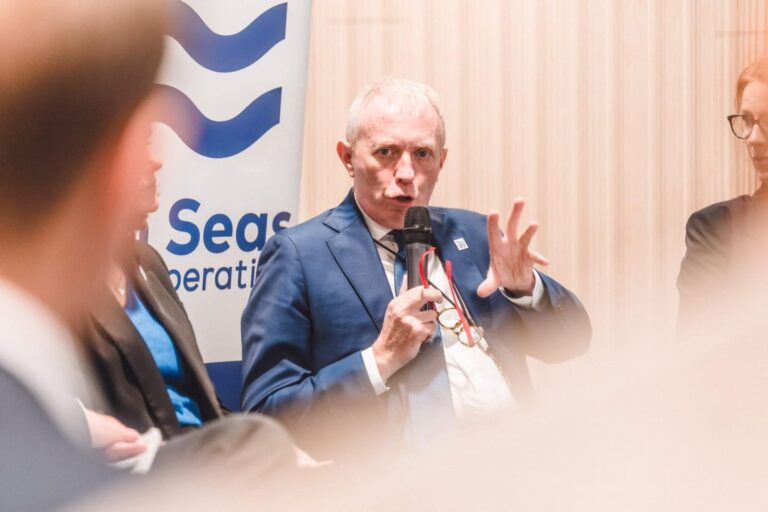
*Junior Minister and Clare TD, Timmy Dooley (FF).
JUNIOR MINISTER and Clare TD, Timmy Dooley (FF) will be leading the Government side in negotiations to try bring an end to the fuel protests which commence this Friday afternoon.
Speaking ahead of the talks the Mountshannon native said the argument that the Government is making massive profits from the rising cost of fuel was “a lovely simplistic argument that doesn’t bear out”.
Last month, the Government took in an extra €6m with motorists paying a higher price for petrol and diesel due to the ongoing war in Irian. New Exchequer figures show that €0.5bn in excise duty receipts was collected in March, up 1.2 percent on the same month last year.
Dooley who is Department of Agriculture, Food, Fisheries and the Marine and Minister of State at the Department of Climate, Energy and the Environment will be joining Minister for Agriculture, Martin Heydon (FG) in the talks which commence at Friday afternoon from 14:00 at Government buildings.
Representative groups of farmers, agricultural contractors and the haulage industry will also be involved in the talks to discuss the ongoing fuel crisis. There has been no confirmation whether representatives of fuel protesters who have been engaged in four days of action will be present for the talks.
In advance of the negotiations, Dooley spoke over the phone at approximately 11am with members of the Clare protest group.
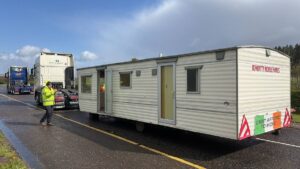
For the discussions, protesters were seated in a mobile home caravan which has been in situ at junction 11 of the M18 in Newmarket-on-Fergus since Thursday evening where road blocks have been mounted.
Members of the Clare protest group were left frustrated as it appears no price cap will be placed on white or green diesel.
Speaking on RTÉ’s Prime Time, the Minister of State cautioned that the State would have to provide the gap between the cap and what oil companies charge if a fuel cap is introduced. “With the minimum intervention that we did last week, it is costing a quarter of a billion a month so if we’re to cap as has been suggested by some on the protest €1.70 for road diesel and agricultural diesel at 90c then you’re looking at a billion a month”.
Ongoing war in the Middle East has led to the Government profiting with the cost of fuel but Dooley said, “That is a lovely simplistic argument that doesn’t bear out, I’m suggesting the costs of doing what is suggested will cost the taxpayer €1bn, there’s smaller money in reserves but there certainly isn’t €1bn a month. We have to be conscious, no politician wants to be a loggerheads with people that are struggling but the reality is we can’t put the finances of the State in a perriless situation”.
Confusion remains over who will form part of the negotiating team meeting Dooley and Heydon. “To the best of my knowledge we are meeting with the representative bodies, I don’t know who they are bringing, they are bringing a number of representatives but that will be a matter for themselves”.
He added, “My very clear understanding is invitations have been issued to representative bodies who have an opportunity to bring a delegation to the meeting. My knowledge is we have extended invitations to the representative bodies to continue dialogue that started last week between Minister Heydon and the Tánaiste, there were proposals put forward at that which did include the IFA, the ICSMA, contractors, groupings and associations, my clear information is those groups have been invited and will be in attendance tomorrow”.
Dooley said, “The Government’s position is that we are meeting with representative groups which have been invited, who they choose to bring with them whether they are in their membership or not is a matter obviously for those representative bodies”.
Disruption caused by the road blockages needs to end, he said. “Everybody is concerned about the impacts on their lives and livelihoods on the cost of oil. I know many of the people on the protest, I have spoken with them, I know their issues and their concerns but there is a big difference between a protest and a blockade, we have to get to a point where the blockade and the access to clean water, fuel and allow people to get to appointments”.
Potential of bringing in the army to de-escalate the ongoing protests has caused concern and drew criticism. “That is a position of last resort, we accept and understand in any democratic society the right of every citizen regardless of how difficult a situation is to protest and involve themselves in peaceful protest, there is a big difference between a peaceful protest and a blockade, we have a situation where people can’t get access to fuel, the crisis is in the Middle East and yet here we’re preventing people from getting access to fuel and go about their daily lives and get to hospital”.