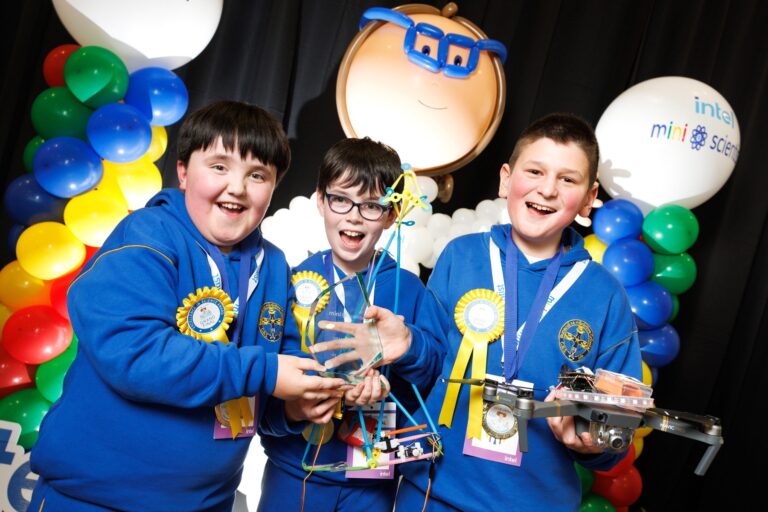
Overall winners Aidan Hehir, Sam O’Neill and Franky Giudici from CBS Primary Ennis, overall winners for the Intel Mini Scientist. Photograph: Marc O’Sullivan
THREE PUPILS FROM CBS Primary Ennis beat students from all over Ireland to win the 2025/2026 Intel Mini Scientist competition.
Aidan Hehir, Sam O’Neill and Franky Giudici won the top prize for their project examining how does a catapult work. They fended off competition from more than 5,000 students from 75 schools in 15 counties who also participated in the nineteenth annual Mini Scientist Competition.
By investigating the principles of kinetic and potential energy, the students analysed how a catapult operates, from the initial storage of energy to its release at launch.
Sarah Sexton, Intel Public Affairs Director, and Kenny McNamee, Senior Principal Engineer at Intel presented the Ennis trio with their prizes. As part of the prize, CBS Primary Ennis will receive a grant of €1000 from Intel.
At the Grand Final held at the TU Dublin Blanchardstown campus, the top 70 projects from around the country were showcased. From chemical cabbages to AI chatbots, these budding scientists brought all sorts of creative ideas to life for the judging panel. The competition began in September for fourth, fifth and sixth class students.
Starting with projects exhibited within their own schools, Intel employees visited each participating school to select a project that was invited to move forward to the grand final.
Commenting on the overall winning project Head Judge, Sheila Porter, SciFest Founder & CEO said, “The Intel Mini Scientist competition is a wonderful opportunity for young students across the country to showcase their scientific knowledge and innovative ideas. The diverse range of projects presented by today’s finalists has been really impressive. From renewable energy to artificial intelligence, the depth of thinking and teamwork on display reflects the remarkable talent and creativity of these students”.
Intel Public Affairs Director Sarah Sexton praised the commitment to such a high standard of projects by the thousands of students. “The competition is a great way to get children excited about science and technology and to give them the opportunity to build key skills, such as critical thinking, problem solving and teamwork”.