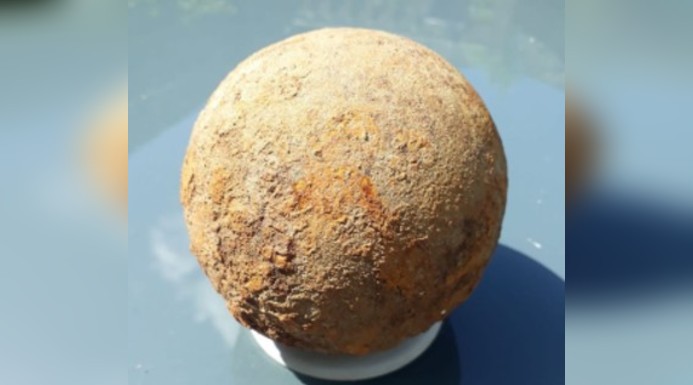
Clare County Museum announced its latest acquisition at the end of May, a cannonball found at Ballycar, Newmarket on Fergus, believed to be dating back to a Cromwellian garrison that took place at the now defunct Ballycar Castle, in retaliation for the 1641 Catholic Rebellion.
The cannonball was discovered a mere six inches from the surface by Nathan Maxwell on May 12th, as he was digging a fence post in his garden. The find was subsequently reported to the National Museum of Ireland in Dublin who contacted Clare Museum’s curator, John Rattigan, whom under the National Monuments Act, is permitted to collect archaeological objects belonging to the state.
The absence of a medieval archaeological site in Ballycar puzzled Mr. Rattigan, who sought out local Historian and a specialist in the area of Clare Tower Houses, Martin Breen. In 2014, Mr. Breen along with his colleague Dick Cronin, submitted a comprehensive study on Tower Houses and Castle in County Clare. The study comprises of detailed sketches, mappings and an in depth look at two hundred and twenty castles within the county.
Following a rigorous examination of online maps, Martin concluded that the cannonball came from a once prominent tower house called Ballycar Castle, posited 610 metres away from the site of the cannonball.
Mr. Breen maps out the elaborate and expansive history of the tower house, “A tower house was the typical building of a medieval landowner, similar to a little village or extended farm. The castle was built in around the 1500’s by Conor McNamara. There were about 80 castles built by the McNamara’s in South-East Clare. In 1563, the castle was demolished by Conor O’ Brien III, Earl of Thomond at the time. The O’ Brien’s abided to be bound by English law in 1543. It was during this O’ Brien in-fighting for succession of the kingship that Ballycar was demolished.
“It was subsequently rebuilt and we know that it existed up until the 1800’s. Donough O’Brien, a truly Anglicised ruler, planted his lands with English settlers as they were better to pay rent. In 1641, during the Catholic Rebellion, Ballycar Castle was attacked. The Cromwellian retaliation then took place after this and there is a reference to Ballycar being used for a Cromwellian Garrison in 1654. The cannonball was more than likely found in a Cromwelian Gun Emplacement”.
Now vanished from the land, Ballycar Castle was pillaged and quarried for stone in the 1800’s, as people moved out to more competent and functional country houses. Martin alludes to the last and only physical recording of it, sketched by travel writer and antiquarian, Thomas Dineley in 1681 during his travels of Ireland. The sketch shows the exact location where the castle existed and Martin’s detailed survey led him to the foundations at the back of Ballycar Lake, where an association of houses remain, once part of the medieval tower house.
The cannonball was discovered alongside a crab tree, which Martin identifies as, “hugely historical on its own right.” The old crab tree road, now closed, was utilised as a coach stop, connecting Limerick to Galway through Ennis. Recorded in one of the Traveller Gazette’s, the crab tree stop was used for coaching horses. Travellers passing through would change horses or stay the night at this exact location. The road can be seen on the 1840’s ordnance survey maps. Martin labels the stop as a well known and important point, sporting a historical building at the time. This stop is located half a mile from the site of Ballycar Castle, supporting the strong argument that the cannonball was buried here in relation to the Cromwellian reign.