
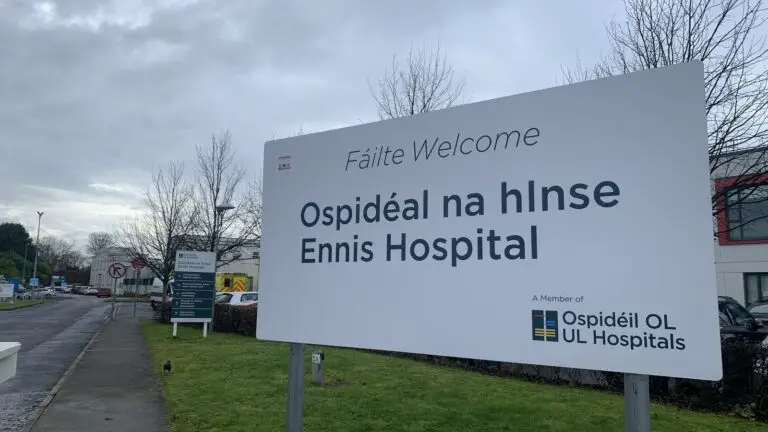
*Ennis Hospital.
UNIVERSITY HOSPITAL LIMERICK (UHL) has an average of 25 bed blockers per day and Ennis Hospital has five patients per day occupying beds in acute care that could be treated elsewhere, new analysis has revealed.
Capacity pressure on the Mid-West’s only emergency department has been added to by the presence of patients medically approved for care elsewhere occupying acute beds at UHL.
Prepared by intermediate care specialists, Bartra Healthcare, the new Mid-West Hospital Capacity Tracker has analysed public health data to evaluate capacity pressures at the region’s five hospitals. It found that during the first nine months of 2026 (January to September), an average of 38 patients a day were occupying acute beds despite being medically approved to move to the next stage of care at an alternative appropriate healthcare setting elsewhere.
At UHL, 25 acute beds are occupied every day by patients medically approved for care elsewhere.
Data shows that pressure increased significantly at four of the hospitals in the region, UHL, Ennis Hospital, Nenagh and St John’s Hospital over the first nine months of 2026. The monthly average of patients still in acute beds yet medically approved for care elsewhere rose from 23 beds in January to 46 in September. August recorded the highest monthly average of the year, at 49 acute beds continuing to be occupied by patients medically approved for care elsewhere. On 14 August, that figure reached a peak of 66 beds.
UHL had the highest nine-month daily average at 25 beds, reaching a high of 33 in August. The trajectory shows that pressure was higher in the summer period rather than winter.
For Ennis hospital, the average daily number of patients in beds approved for healthcare elsewhere hit a peak of five for March, May and June. It was three for January, February, July, rising to four in September and down to one for April.
The analysis also highlighted the level of hospital capacity being redeployed from its intended use in response to demand pressures and the impact this may be having on scheduled care. At UHL, an average of 28 hospital beds a day were redeployed from their originally intended use to meet ongoing demand pressures. The figures point to a persistent requirement to redeploy beds from their intended use at UHL, with the monthly average not falling below 23 beds a day during the period, reaching a high of 30 in four of the nine months analysed.
Redeployed beds can impact scheduled care, day cases, procedures and assessments, often resulting in appointments being postponed or cancelled, thereby impacting waiting lists. A monthly average of 8,009 adults were waiting for an inpatient or day-case appointment over the period. UHL accounted for 43% of those waiting for an appointment.
Angela Ring, Chief Executive, Bartra Healthcare stated, “We can see that the consequences of capacity pressures extend from the patient waiting to move to another care setting, to people waiting for an acute bed, and ultimately to those waiting for scheduled care. The UHL figures demonstrate that capacity squeeze particularly clearly, the persistent build-up of pressure, and the domino effects this has in a wider sense.
“Good patient flow is about ensuring the right patient is receiving the right care, in the right setting, at the right time. Appropriate intermediate care is one important release valve, among others. The challenge is to ensure sufficient capacity exists across the wider health system to allow that movement to happen when the patient is ready,” she added.
Bartra Healthcare in May opened an 80-bed facility located 1.8km from UHL which they insist can ease the overcrowding. Bartra operates 331 intermediate care beds across three facilities, Beaumont Lodge, Clondalkin Lodge and Raheen Lodge in Limerick. Its 200-bed Beaumont facility operates in partnership with Beaumont Hospital, Connolly Hospital and Our Lady of Lourdes Hospital, Drogheda. Hospital consultants refer patients directly to the facility for intermediate care and undertake ward rounds there, enabling patients who no longer require an acute hospital bed to continue receiving appropriate care outside the acute hospital setting.