
AN ENNIS dentist-turned-historian has unveiled the truth behind one of Ireland’s most misunderstood eras — World War II.
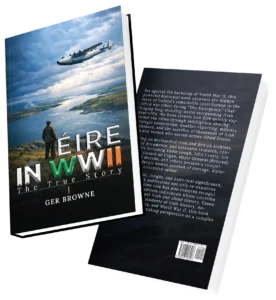
Ger Browne’s monumental 650-page work, Éire in WW2 – The True Story, sets out to dismantle decades of misconceptions surrounding the Emergency, bringing to light a sweeping record of Irish cooperation that has long been obscured.
Originally a Corkman from Douglas who has called County Clare home for four decades, Ger ran the Ennis Dental Health Centre for years before retiring to focus on his lifelong passion for history.
Local readers will already be familiar with his work, from his 125-year history of the Ennis Lawn Tennis & Badminton Club to more than 38 research booklets published on the Clare Library website, cataloguing thousands of local records from the Revolutionary period, the RIC, and earlier global conflicts.
It was while researching earlier military campaigns that Ger encountered a glaring historical puzzle. “I came to a brick wall in World War II,” Ger explains, noting that the Irish diaspora had historically won a third of all US Medals of Honor and 190 Victoria Crosses.
“How could a country whose people had served in such numbers suddenly stand aside? I wanted to know what really happened in World War II and the Emergency”.
The turning point came when Ger read a groundbreaking paper by retired lecturer Donard de Cogan regarding Fort Shannon, a secret wartime military base on the Shannon Estuary. Built south of Scattery Island with British technical assistance, Fort Shannon was fitted with two massive artillery guns designed to protect the mouth of the estuary.
“I know all about the Napoleonic forts on the Shannon Estuary, but I had never heard of Fort Shannon,” says Ger. “It was built in late 1942 to defend Foynes, which was virtually the most important airbase in the world at the time.”
During the war, Foynes served as a vital transatlantic hub for VIPs, top military brass, and legendary Yankee Clipper flying boats.
“Everybody and anybody flew through Shannon,” Ger recalls. “Anyone living along the Shannon Estuary in Clare knew something massive was happening because those planes were flying overhead every single night”.
A central focus of Éire in WW2 – The True Story is confronting the enduring fables that painted wartime Ireland as harbouring German sympathies. One of the most persistent legends claims German bombers used Dublin’s streetlights to navigate before attacking British targets.
“That German planes bombing Liverpool flew across the Irish Sea just to see the lights on in Dublin and then returned is absolutely ridiculous,” Ger says. “It is the equivalent of the Allies flying to Stuttgart, crossing into neutral Switzerland to look at Basel’s lights, and then flying 30 minutes backwards”.
Ger similarly dismisses claims of German U-boats refueling in western bays. In reality, the RAF stationed aircraft at Foynes alongside dozens of maritime patrol planes continuously surveying the West Coast to ensure no submarine refueling ever took place.
He also sets the record straight on Éamon de Valera’s post-war visit to German Minister Eduard Hempel. “There was no book of condolences opened or signed — de Valera did not sign anything,” Ger clarifies.
Hempel was a career diplomat, and de Valera offered him and his family temporary asylum, during which Hempel remained in Ireland for four years before later joining the West German diplomatic corps.
In private, de Valera explicitly assured British authorities that Ireland would extend every possible assistance short of declaring open war.
Behind the official veil of non-alignment, practical cooperation with the Allies was extensive.
Gardaí provided character references for Irish recruits, downed Allied airmen were escorted to the Northern border within 24 hours to rejoin their units, and Irish agricultural exports fed wartime Britain in exchange for coal and fertilizer.
Meanwhile, German personnel were interned for the duration of the war.
For Clare, the strategic footprint was immense. At Rineanna — now Shannon Airport — concrete runways extending up to 5,000 feet were constructed, accompanied by underground communication tunnels, gun posts, accommodation, a church, and wireless facilities. “One engineer who worked at Rineanna said it was run just like an American airbase,” Ger notes.
“American pilots landing there nearly always demanded to stay overnight because word had gotten out that it was a great place to land”.
Along the coast, 82 numbered lookout posts — including Loop Head — provided navigational air signs for Allied aircrews, while right in Ennis, near Friar’s Walk, a town memorial stands to honour the 70 Clare men and women who lost their lives during the conflict.
The core of Ger’s work is an exhaustive alphabetical directory profiling 5,411 men and women from Éire who died during World War II. Ger stresses that this count — based strictly on primary next-of-kin records — is a conservative baseline.
“As more archives open, the true figure could reach 8,000 or 10,000, representing a proportional sacrifice equal to that of the United States,” he observes. Over 70 tons of official government documents were destroyed after the war, contributing to decades of silence.
“The Irish diaspora took an immense amount of flak over the years regarding an alleged pro-Nazi stance,” says Ger. “They deserve to know the hard, documented truth of what really happened”.
Featuring a formal introduction by Ennis native, Major General (Retired) Adrian Ó Murchú, the 650-page book incorporates specialized contributions from historians Jim O’Neill, John Crotty, and Donard de Cogan alongside Ger’s extensive analysis and casualty roster. Ennis man Eddie Lough, supported Ger by digitising the 24,000 pages of research.
Designed specifically for general readers without dense military acronyms, the volume is structured so anyone can open a page and engage directly with the material.
Éire in WW2 – The True Story is available locally in Ennis at The Ennis Bookshop, in Lahinch Bookshop, and Banner Books in Ennistymon and Kilrush, as well as online from Amazon and via www.gerbrowne.com.