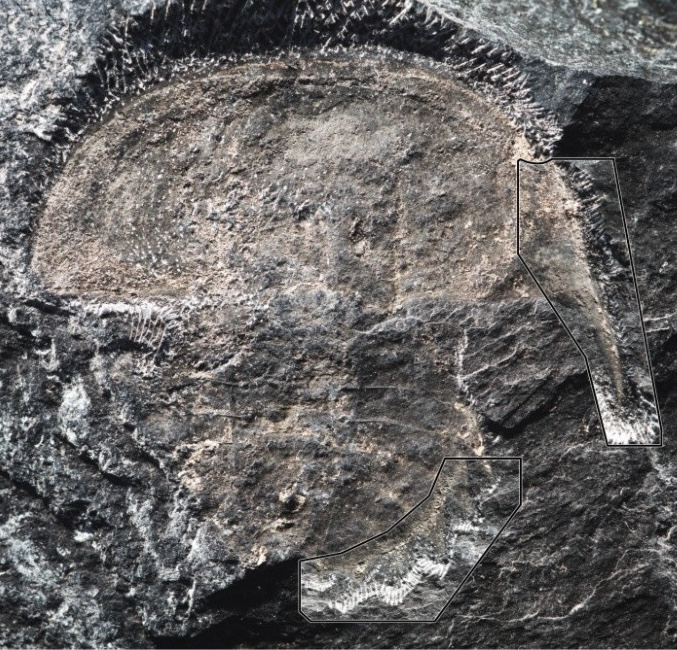

A HORSESHOE crab fossil dating back more than three hundred million years, has been discovered at the Burren UNESCO Global Geopark.
Identified as Euproops danae, a species familiar to the UK, Europe, Russia and North America, the fossil is only two centimeters in size. This is the first record of this species in Ireland and the first new horseshoe crab fossil to have been discovered in Ireland since the 1800s.
Dr Pierre Gueriau, a specialist in arthropod fossils from the University of Lausanne, Switzerland discovered the fossil near Doolin. He found the petrified remains while conducting collaborative fieldwork with Dr Eamon Doyle, Geologist for the Burren and Cliffs of Moher UNESCO Global Geopark. “I was amazed to find this fossil after many hours of searching. I immediately knew that it was a significant find and an important addition to the known fossil fauna of the rocks of Clare and Ireland,” Dr Gueriau stated.
“I had previously found the tiny footprints of horseshoe crabs preserved in the rocks here as trace fossils, so seeing an example of the actual animal that made them was thrilling. This discovery highlights the benefits of collaborative work with international colleagues,” Dr Doyle outlined.
The discovery has been published by Dr Gueriau and Dr Doyle in the latest issue of the Irish Journal of Earth Sciences.
The Clare Shale Formation, where the fossil was located, is a mudstone deposit that was formed in a relatively deep sea near the equator. It has taken 320 million years for the rocks to be transported to where they are now on the west coast of Clare.
It is likely that the horseshoe crab, which is not actually a crab but a representative of xiphosurans, a different type of arthropod closely related to scorpions and spiders, was transported into deep water by offshore currents before dying and being preserved as a fossil.
Most Carboniferous horseshoe crabs are found in very shallow water deposits. Modern horseshoe crabs come ashore in their thousands on sandy beaches along the east coast of the USA for spawning, excavating nests and laying thousands of eggs. It is not known if the ancient fossil forms behaved in a similar way. The specimen is curated in the collection of the Geological Museum of Trinity College Dublin.