
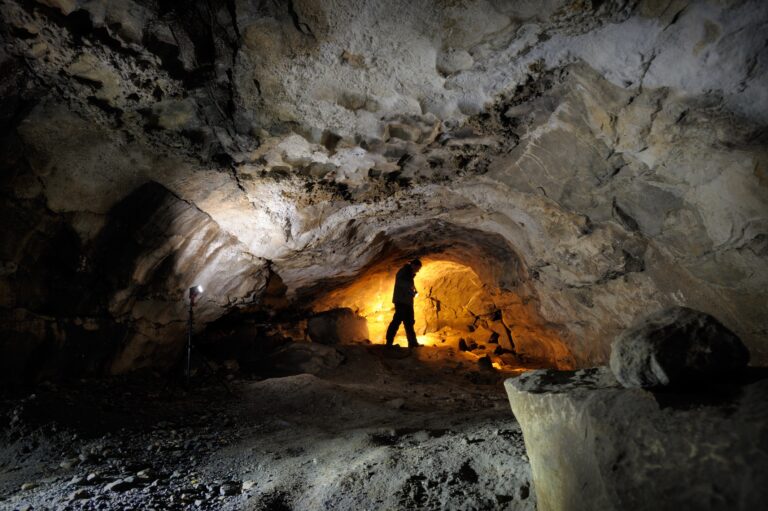
Glencurran Cave in the Burren, County Clare, where the earliest directly dated wildcat (Felis silvestris) ever found in Ireland was discovered. Photograph: Ken Williams
IRELAND’s first known wildcat bones dating back 5,500 have been located in The Burren.
Glencurran Cave which is the only cave in Ireland where a cairn or burial structure has been discovered is now also the site where the earliest directly dated wildcat (Felis silvestris) ever found in Ireland has been identified, confirming the species lived on the island more than 5,500 years ago.
Dr Marion Dowd an archaeologist at Atlantic Technological University (ATU), made the discovery which marks a breakthrough in understanding Ireland’s prehistoric wildlife and ecology.
Archaeological excavations at Glencurran Cave uncovered the bones which date to around 3600 BC (Neolithic). Until now, no prehistoric cat remains in Ireland had been radiocarbon dated, leaving long-standing uncertainty over whether early finds represented wildcats or later domestic intrusions. The research, published in the Journal of Irish Archaeology, also formed part of a major international study published in Science, which analysed ancient cat DNA across Europe.
During excavations, 39 bones belonging to an adult wildcat were discovered deep within Glencurran Cave. There were no cut marks or evidence of human interference, indicating the animal died naturally inside the cave. The bones were identified by zooarchaeologist Margaret McCarthy.
Radiocarbon dating carried out at Queen’s University Belfast confirmed the remains were over 5,500 years old. Ancient DNA sequencing by Prof Claudio Ottoni and his team at the University of Rome Tor Vergata further verified the animal as a European wildcat- distinct from both modern domestic cats (Felis catus) and Near Eastern wildcats (F. lybica lybica). The aDNA also showed that the Glencurran wildcat was a male and belonged to an ancient European lineage, closely related to wildcats from Italy and Spain, rather than the modern Scottish population.
Dr Dowd stated, “This is the first time we can say with certainty that European wildcats lived in prehistoric Ireland. It transforms what we thought we knew about Ireland’s ancient wildlife”.
For decades, small numbers of cat bones were found on prehistoric sites, including the Mesolithic site of Lough Boora, Co. Offaly and the Neolithic passage tomb of Newgrange, Co. Meath, but without radiocarbon dating, it was impossible to confirm their age or species. “This discovery finally gives us solid evidence that wildcats were here in the Neolithic. The ancient DNA results were especially exciting. To see this Irish wildcat grouping with animals from southern Europe tells us it belonged to a much older, wilder lineage than our domestic cats today,” she said.
“We simply don’t know when wildcats arrived in Ireland or when they vanished. Medieval writers mention wildcats in the Irish landscape, but these may have been feral domestic cats. Confusion is also common with the pine marten- known in Irish as cat crainn, or ‘cat of the trees’,” Dr Dowd explained. “This find makes clear that we need to radiocarbon-date and analyse other cat bones from prehistoric sites across Ireland. Without radiocarbon dating and aDNA analyses, we cannot separate true prehistoric wildcats from later domestic cats”.
Wildcat was once widespread across Europe but declined sharply from the 1700s due to habitat loss, hunting, and competition with domestic cats. As the domestic cat population grew, wildcat numbers plummeted. Wildcats prefer forest habitats and avoid humans, living mostly solitary, nocturnal lives. Although similar in size and appearance to domestic cats, they are a different species.
Dr Dowd noted, “This project shows what can be achieved when archaeology, radiocarbon dating, and genomics come together”.
Further analyses of cat remains from other sites may ultimately reveal how wildcats reached Ireland, how they lived, and when and why they vanished from the Irish landscape.